Low Back Pain
Classification of Low Back Pain
- Based on Duration
- Acute= 0-3 months duration; immediate onset
- Subacute= 0-3 months duration with slow onset
- Chronic= > 3 months duration
- Recurrent= Recurring after a pain-free interval
Why take it seriously?
- Acute low back pain is often recurrent,
- Predisposes to chronic pain and disability
- A warning of potential future trouble
- Impacts on the Quality of Life
- Lost days of productivity
- The huge cost of incapacity payouts
- The enormous burden on healthcare costs when chronic
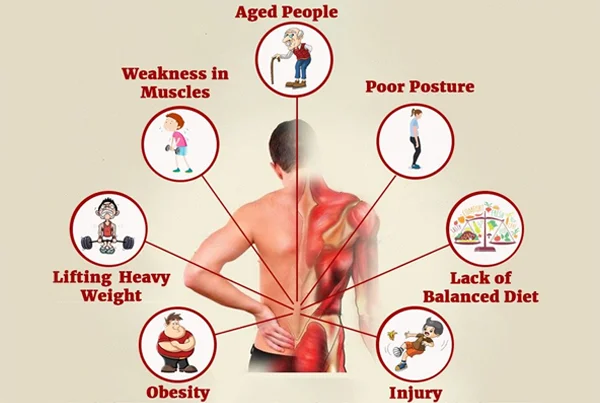
Factors Associated with Back Pain
Disc Prolapse
Tips to Prevent Lower Back Pain
- Exercise your core: Strong core muscles are important to provide support for your lower back and avoid injury
- Correct your posture: Poor posture places pressure on your back and can cause deteriorated discs to become even more painful
- Lift heavy objects correctly: You can injure your lower back if you lift a heavy object incorrectly. Make sure you bend at the knees and hips (not the back), keep your chest forward, and keep the object close to your body.
Physical therapy
- Back flexion and extension stretching - beneficial effects
- Flexion-based isometric exercises - most support in the literature, although extension-based exercises --useful adjuncts.
- Decrease local muscle spasms and stabilize the spine
Few Exercises
Surgical Treatments
Surgery in Acute Low Back Pain
- 80% of patients with Sciatica recover eventually without surgery
- For severe, progressive neurologic deficits/cauda equina and lack of improvement in patients with sciatica or neurogenic bladder/bowel dysfunction
- Abnormalities based on clinical exam and then correlated with CT, MRI, EMG
Probable Surgical Treatments
- Discectomy
- Discectomy with fusion
- Discectomy, fusion, and instrumentation.
- Lumbar discectomies can be
- Open
- Percutaneous discectomy
- Laser discectomy and
- Endoscopic removal of herniated disc fragments.